Hello! I´m Mª Angeles and this week i have had to be the journalist in my group.
The dynamics of this week has been a little different from those of others. We had problem to work together so we had to divide the activity and take it to our houses.
Each had an assigned text and then we had to take all possible PostCard.
Once we had all stayed to organize and to make a conversation and the truth is that I think we did a good job.
The procedure we used this week has been effective, but we like more work together.
lunes, 16 de abril de 2012

miércoles, 28 de marzo de 2012
Comic
Sorry, a bit late but this is the comic that we did with Manel Rives some weeks ago.
A short story about a dinosaurs' family who while they are celebrating the born of a new member of the family, suddenly, start to note how the climate is changing, they decide to move to another place loking for better clime (the start of the extinction).

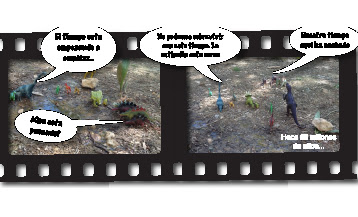
We could say that with this practice we have discovered again that it's not as easy as it looks and it's incredible how children of twelve years or less do this and better than us :).
María.
martes, 27 de marzo de 2012
Toontastic.
Hello everybody! I am Marta and I was the responsible for upload the toontastic work, and right now we got it. So here is the link http://toontube.launchpadtoys.com/17808/ and I would like to say that, this experience were very enriching for us, but by the practical, to have this facilities (like Manel tell us) cost lot of time, patient and of course, continuity and effort, for both parts.
This is a very good way to teach, so in our opinion, it will have future.
jueves, 15 de marzo de 2012
Stop Motion
Hi
everyone!
I´m Mªangeles, the start of this week and i´m going to talk you about our Stop Motion!
Our Stop Motion is about a couple of Tuojiangosaurus who are enjoying a fantastic sunny day strolling though the woods. Carefree walk talking about their lives and about the plants had tasted that morning. Suddenly they found a Paquicefalosaurus wounded on the ground. They ran to save him and thought about calling an ambulance.
In just two minutes the ambulance arrived and took the beloved Paquicefalosaurus and doctors said he was going to be fine.
When the ambulance left, the Tojiangosaurus couple continued their walk. Hours later, the Paquicefalosaurus was behind them to thank for saving him. Apparently he had been attacked by a Tyrannosaurus Rex but had fortunately escaped.
Finally the three dinosaurs went for a walk and became food friends.
Tehy were happy, but did not eat partriges, because our dead friends were berbivorous dinosaurs :)
THE END :D
We are not experts in photography, and needed a tripod because the camera was moving, but we have been too bad, I leave here, I hope you like it!
http://www.youtube.com/watch?v=6g7uB1ngHIU
I´m Mªangeles, the start of this week and i´m going to talk you about our Stop Motion!
Our Stop Motion is about a couple of Tuojiangosaurus who are enjoying a fantastic sunny day strolling though the woods. Carefree walk talking about their lives and about the plants had tasted that morning. Suddenly they found a Paquicefalosaurus wounded on the ground. They ran to save him and thought about calling an ambulance.
In just two minutes the ambulance arrived and took the beloved Paquicefalosaurus and doctors said he was going to be fine.
When the ambulance left, the Tojiangosaurus couple continued their walk. Hours later, the Paquicefalosaurus was behind them to thank for saving him. Apparently he had been attacked by a Tyrannosaurus Rex but had fortunately escaped.
Finally the three dinosaurs went for a walk and became food friends.
Tehy were happy, but did not eat partriges, because our dead friends were berbivorous dinosaurs :)
THE END :D
We are not experts in photography, and needed a tripod because the camera was moving, but we have been too bad, I leave here, I hope you like it!
http://www.youtube.com/watch?v=6g7uB1ngHIU
viernes, 9 de marzo de 2012
Manel Rives.
During this week, Manel Rives, a primary teacher from Galicia, has come to explain us how does he work with their students, during his speach, he make us change our way of thinking, discovering that teach with media is easier than we think, that children of all ages can work whit it and make thing like a Power Point, a Stop Motion, a Comic or even a Cartoon quite good.
After his speach, we try to make, to create the same things that his students do, working with dinosaurs, making a Stop Motion, a Comic and also a Cartoon, speending one hour or even more, outside, taking photographs, recording our voices for the cartoon, having a good time but also learning a lot with these. At the end, we realised that most of the student's that Manel has in Galicia are better than us working with Media, problably, due to the education that we have recibed.
After the visit of Manel, Linda has been asking us different questions about it, what was our opinion and impresions and also getting us a bit more imformation about this topic.
1.What was the best part of the activity?
Generally, the activity was amazing for us, but we think that the best thing of the activity was the begining when Manel explain us how his way of work was, because we have never seen something like that, because he was able to persuade us about the importance of his methods, showing us that learning was possible.
2. What was the worst?
The activity was completely positive, despite being for four hours working, we didn't get bored, enjoyin we we were enjoying it and learning a lot.
3. What was the best moment of the week?
Like always, we think that the best moment of the week was when we met for take the photos to the Stop Motion because we had a good time together.
4. What was the worst?
In our opinion the worst moment was when we had to make the s¡Stop Motion because it was so bored and the pc program didn't work properly.
5. What have you learnt?
We have learnt that exists other way of teaching based in media and children can learn a lot with it.
We also learnt a lot of creative methods and contents that makes children enjoy while they are learning.
6. What do you need to conserve?
We need to converse all that we learn thanks to Manel, trying to implement them in a future teaching.
7. What do you need to improve?
We need to improve our organization.
 |
| Manel Rives during his amazing speach |
Generally, the activity was amazing for us, but we think that the best thing of the activity was the begining when Manel explain us how his way of work was, because we have never seen something like that, because he was able to persuade us about the importance of his methods, showing us that learning was possible.
2. What was the worst?
The activity was completely positive, despite being for four hours working, we didn't get bored, enjoyin we we were enjoying it and learning a lot.
3. What was the best moment of the week?
Like always, we think that the best moment of the week was when we met for take the photos to the Stop Motion because we had a good time together.
4. What was the worst?
In our opinion the worst moment was when we had to make the s¡Stop Motion because it was so bored and the pc program didn't work properly.
5. What have you learnt?
We have learnt that exists other way of teaching based in media and children can learn a lot with it.
We also learnt a lot of creative methods and contents that makes children enjoy while they are learning.
6. What do you need to conserve?
We need to converse all that we learn thanks to Manel, trying to implement them in a future teaching.
7. What do you need to improve?
We need to improve our organization.
 |
| TBGOB planing the activity. |
Manel Rives
is a public school teacher working in a school nursery and primary education in
a village near Santiago of Compostela. Manel approved the specialty of physical
education has been but where you feel most comfortable is in the area of
environmental knowledge. Think that this area connects with our reality and
the rest of 3 disciplines.
He is
considerer that he use a different computer platforms to promote a different
way of teaching. In his opinion the centers should have a certain belief in
seeking their own concerns, take risks in technology decisions and create
different projects. He confesses that attempts to find alternative languages
and different forms of expression for children. Use the picture and sound as
powerful weapons that children should be able to control for efficient
development. Podcast, videos, comics, presentations, animations, stopmotions
... are some of the things that children 12 years know how to handle him.
After years
of struggle to get media, now has 6 I pads for him and his students.
It
encourages children to memorize hundreds of things but they know how to get
that information, which are self sufficient.
With the
intention and hope that this teacher has we can see that a different way of
teaching is possible.
 |
| TBGOB with Manel Rives |
Facilitator: MªÁngeles Abenza Hernández.
Journalist: María García Buedía.
Analist: Marta Gimenez Peinado.
Tracker: Irene Aroca Esteban.
Un Wiki Bestial! (Pecha Kucha)

Hi everyone!
This week we have done an interesting practice
called Pecha Kucha,
It consists in a creative, clear and concise
presentation that uses 20 x 20 format, twenty slides for twenty
seconds. The presentation was in pair and each star had to explain clearly a slide within 20 seconds.
We did a lottery in class to see that issues that
Linda had chosen we played to each group. We had to do “Wiki
Animals”, a project designed to make by searching for information
on animals, as well as cultural enrichment, more self-sufficient to cope when looking for information, using computers, creating templates and so
on. .
Finally the wikianimal’s
project permit us to discover that another way of doing things is possible. Improves students' internet in
very early age, and best of all, it is a project
to be spread around the world, and is now part of countries in South
America and,not least, in different languages, which are: German, English,
Castilian and Catalan.
To prepare the work,
Linda explained the guidelines to be followed to create a good presentation. Overall
the presentations were clear and concise but with some exceptions.
In short, we learned a
new way to make presentations in a fun and creative.
 |
| How we prepared our Pecha Kucha. |
To complete
this research work, we will discuss the presentations of other class groups,
granting punctuation to each one, where 12 will be the maximum and 5 the
lowest.
· Broken
dreams: (The Beatles). The first one had a small problem, they presented 26
slides and we had to wait for your presentation.
Secondly,
the Power Point had too many words, and it was not clean and clear, and
finally, not introduce the slides in time.
Our
punctuation to them was: 5
· The
Chalks' Drivers: (Matemáticas sin tiza). This group was fine, as it was
very full of information, with many examples, and one of the most important
things in our opinion, is that they contacted with the teachers, the creators
of this project. The only drawback we could see, was that plenty of time on
some slides.
Our
punctuation for them is: 6
· I know what you did: (Viajar virtualmente). In our opinion this
was the best group, the explanation is perfectly understood, the power point
was full of examples, and they also contacted with the teachers and introduced
a video for explaining it.
The time per slide was correct all the time.
Our punctuation to them was: 12
· Never
too late: (Gymkhana: SOS endangered animals). This group was worse, on
every slide lacked time of explanation and spoke too fast. A bonus was that
their English was very correct, and the photos of the slides is very well
suited to the context.
Our
punctuation to them was: 7
· Color
chameleons: (Parlamento), it was a bit repetitive, they talk a lot about some concepts. On the other hand, they distribute so good their time and at the end they finish their exposition with a vey good conclusion.
Our punctuation to them was: 8
· Hakuna
Matateros: The last one and problably one of the best ones, with a very good presentation (Powe Point), good picutres and so complet with also a good explanation.
Our punctuation to them was: 10
During this
week, and working with the project realised by Mª Felisa Jodar Foz (primary
teacher), we have realised, that lot of projects like the Wiki Animals one
(which we have worked), are being made around Spain, nowadays, we still have
teachers worried, concerned about teaching, which seek to adapt it to the times
we live, working and including all technologies we have to make it easier (they
include media in their teaching and curriculum implementation). Not everything
is done, and not everything is on the books.
1. What was the best part of the activity?
Know the
several projects that are being realised in our country, being so interesting
and varied. Listen our peers explaining theme to us, see how their power points
were.
2. What was the worst?
Discover that
is a pity that there are a lot of projects, trying to introduce media, but
these aren’t enough, we have still more teachers who don’t try it.
Realized
that we hadn’t work enough, we didn’t understand what did we have to do and
most of the presentations were better than our.
3. What was the best moment of the week
(in the work of the group)?
Always, the
best moment of the week, talking about the work of the group is when we met
during the week, trying to organize us, we are so close friend and we enjoy a
lot the little time we have to be together.
4. What was the worse?
Realized
that we hadn’t work enough, we didn’t understand what did we have to do and
most of the presentations were better than our.
5. What have you learnt?
Apart from
the importance of media in our diary teaching, and how these projects are, we
have also learnt that we don’t work enough, or not in the correct way.
6. What do you need to conserve -as a
group- for the next weeks?
Our
friendship, our good relation, and the possibility to say things clear without
bother us.
7. What do you need to improve –as a
group- for the next weeks?
What I have
said before, we need more work, we get easily distracted and sometimes our good
relation is a problem, we start to talk about something else and we forget what
we are really doing, loosing time.
Mª Felisa Jodar Foz, teacher of TIC in Ateneu Instrituctiu Primary School since 2003. Is the coordinator and webmaster of the center.no
Felisa is a teacher who thinks that the education is not stagnant because there is a new educational movement characterized by the news technologies and the media. It exists a new form to see the education, where is not always necessary use the books because the technology can replace them.
Finally she thinks that a new kind of education is possible. The education of the century XXI.
Here we have some photographs of our presentations.
 |
| The best group of bilingual |
 |
| Hakuna Matateros. |
 |
| Broken Dreams |
 |
| I know what you did. Facilitator : Irene Aroca Esteban. Journalist: Marta Gimenez Peinado. Analist: María García Buendía. Tracker: Mª Ángeles Abenza Hernández. |
martes, 6 de marzo de 2012
TPACK.

It was the exercise we did during the second week of the course, in ithis activity, each group (consisted of 4 or 5 person) had to present their work done on the TPCK in the class based on a poster to guide our explanation.
The Star did not explained the presentation to the whole class, but the groups were rotating she explain it individually for each group. The rest of the components of the group that were not the stars and were rotated for each exposure had to aim a good deed and a bad one for each group. There are many types of posters in which we find clear and other not so clear, with endless dates or too much text.
The Star did not explained the presentation to the whole class, but the groups were rotating she explain it individually for each group. The rest of the components of the group that were not the stars and were rotated for each exposure had to aim a good deed and a bad one for each group. There are many types of posters in which we find clear and other not so clear, with endless dates or too much text.
Color chameleons: exposed quickly and clearly known show the contents. The poster was very brief.
Never too late: it was the only group that made ??a salutation and English was very fluent and good.
Never too late: it was the only group that made ??a salutation and English was very fluent and good.
I know what you did: English was undoubtedly very good but not too light poster.
Broken Dreams: his poster was the most complete but thought it might have more fluidity and interaction with listeners.
The Chalks' Drivers: very cheerful and the exposure was complete but should have been more fluid and have prepared better exposure.
Hakuna Matateros: a fair presentation that showed it comfortable but the poster was too confusing to understand. He put many examples to better clarify the process.
At the end of the class discussed by all if we had used or not perform the exercise in which we all agreed that if because thanks to the explanation of different ways with different media had made us better internalize the process of TPCK. As we said constructive criticism that we should be more fluid when giving a class, we should look at the face of our listeners and take away the shame, take out the teacher's voice to speak up, do a little introduction ...
In general, our teacher said that to be the first show was not bad.
At the end of the class discussed by all if we had used or not perform the exercise in which we all agreed that if because thanks to the explanation of different ways with different media had made us better internalize the process of TPCK. As we said constructive criticism that we should be more fluid when giving a class, we should look at the face of our listeners and take away the shame, take out the teacher's voice to speak up, do a little introduction ...
In general, our teacher said that to be the first show was not bad.
 |
| The Best Group of Bilingual |
1. What was the best part of the activity?
In general the activity has been quite positive, but
certainly the best parts was hearing the presentations of our peers and see
their murals as it has been quite interesting. Besides, although it has been
the first presentation Linda has said that it has been very successful and she
has congratulated us for our work.
2. What was the worse?
In our opinion the worst part was the exposition
because it was the first time that we display a long work in English, we were
so nervous and didn't know very well what we had to do and how to organize the
work because of we didn't know the working way of the teacher.
The best moment was when we met on Thursday to prepare
among all the presentation, what the star was going to say and how we were
going to organize the exposition. While we were doing the work, we had a great
time laughing and sharing stories of class. That was the best moment, but when
we are together we always usually have a great time.
4. What do you
need to improve –as a group- for the next weeks?
We must agree on flexible working hours for each, the
days of meet and the organization within the group and the role of each person.
5. What have you learnt?
We have learned what TPACK is and how important is
that the teacher carried out for there to be a meaningful learning, as well as
the different parts that it has and what is used each of them.
6. What do you need to conserve -as a group- for the next
weeks?
We cannot ever change the motivation which we work,
our good relationship and what fun we had when we work together.
7. What do you
need to improve –as a group- for the next weeks?
We must agree on flexible working hours for each, the
days of meet and the organization within the group and the role of each person.
This
week, we worked on the concept of TPACK. This experience was very
enriching, and therefore, my work has consisted of investigate the
definition of TPACK and their greater representative Lee Shulman
Technological
Pedagogical Content Knowledge
(TPACK) is a structure to understand and describe the kinds of
knowledge needed by a teacher for effective pedagogical practice in a
technology improved learning environment. The idea of pedagogical
content knowledge (PCK) was first described by Lee Shulman (Shulman
1986) and TPACK builds on those core ideas.
Lee S. Shulman is
an educational psychologist who
has made notable contributions to the study of teacher education,assessment of
teaching, and education in the fields
of medicine, science and mathematics.
He is a professor emeritus at the Stanford
University School of Education,
and the recipient of several awards recognizing his educational
research. From 1963 to 1982, Shulman was a faculty member at Michigan
State University,
where he founded and co-directed the Institute for Research on
Teaching (IRT).
Among his many
achievements, Shulman is credited with bringing the phrase "Pedagocical Content Knowledge"
(PCK)"
into research discourse.
 |
| Color Chameleons |
 |
| Hakuna Matateros |
 |
| I know what you did |
 |
| Never too late |
 |
| Broken Dreams |
 | |||||||||
| The Chalk's Drivers |
Facilitator: María García Buendía
Journalist: Irene Aroca
Analist: MªÁngeles Aabenza
Tracker: Marta Gimenez Peinado
Suscribirse a:
Entradas (Atom)